Five production patterns from the first five AI in Production Field Notes
If you own the ML platform, run infra, or ship LLM features that have to survive real traffic, you already know the punchline:
Most ML/GenAI systems don’t fail because the model is “bad.”
They fail because everything around the model gets stressed the moment users show up.
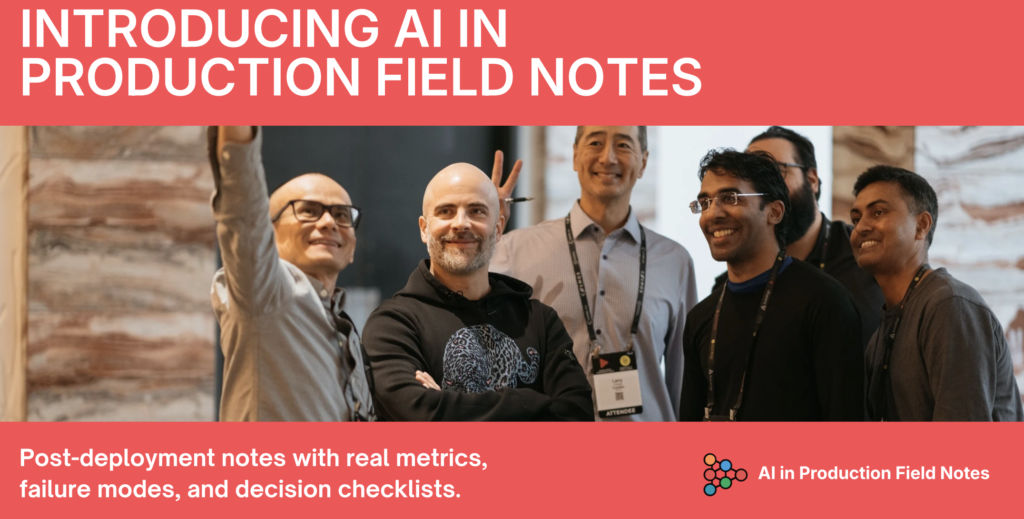
That’s why we launched the first five issues of AI in Production Field Notes: long-form writeups grounded in real production architectures, metrics, and decision frameworks. Not thought leadership. Not “AI takes.” Post-deployment notes.
This post is a short front-door summary: the five patterns we keep seeing, and what they imply for how you build.
Who this is for
- ML platform owners
- MLOps / infrastructure leads
- Applied ML engineers shipping to production
- Research engineers responsible for system reliability
If you’re still in demo-land (no latency budget, no access control, no incident response), bookmark it for later.
Pattern 1: RAG doesn’t fail because embeddings are “bad”
RAG fails because retrieval becomes a systems problem.
In the notebook, RAG looks clean: chunk → embed → retrieve → generate.
In production, it turns into:
- Latency budgets you didn’t plan for (p95, not average)
- Cost creep every time someone says “just add more docs”
- Metadata chaos (what version, what source, what scope, what ownership)
- Permissions bolted on late (and then everything breaks)
- Evaluation gaps that let regressions ship quietly
The reason this hurts is simple: retrieval is now part of your app’s critical path. You’re not “adding context.” You’re operating a distributed system that decides what the model is allowed to see, under time pressure.
Opinion: If your RAG system doesn’t have a real plan for entitlements, cost tracking, and retrieval eval, it’s not a production system. It’s a demo with a pager attached.
Pattern 2: Teams confuse agents with workflows
Agents are seductive because they feel like progress. They also make failure modes harder to see.
Here’s the practical rule we keep coming back to:
If you can solve it with a workflow, an agent is usually expensive overengineering.
A workflow is deterministic. You can reason about it. You can test it. You can budget it.
An agent adds loops, tool calls, dynamic step counts, and “it depends” everywhere, which is exactly what you don’t want when reliability and cost predictability matter.
That doesn’t mean “never use agents.” It means you earn agents when simpler approaches stop working:
- Start with a strong prompt + examples
- Then try sequential steps with validation gates
- Only then consider agentic loops
Opinion: Most agent failures aren’t “the agent isn’t smart enough.” They’re “we added agency when we needed control.”
Pattern 3: Drift isn’t an event. It’s Tuesday.
Traditional monitoring tells you servers are up. It doesn’t tell you your model is quietly becoming wrong.
In production, drift shows up as:
- behavior shifts (users, fraudsters, markets, seasonality)
- upstream changes (schema updates, instrumentation, pipelines)
- label shifts that cascade through downstream systems
What separates mature teams isn’t “we detect drift.” It’s what happens next.
The Field Notes pattern here is: drift management becomes an ops loop:
- detect anomalies
- confirm drift vs noise
- classify severity
- diagnose likely root causes
- intervene safely (retrain, rollback, repair features, canary, escalate)
Opinion: If your pipeline can’t diagnose → intervene with guardrails, you’re not running ML. You’re running a permanent incident queue.
Pattern 4: “Single-call LLM apps” turn into orchestration systems
A lot of LLM products start as: “It’s just one call.”
Then the real world arrives:
- malformed outputs
- partial failures
- timeouts
- retries that amplify cost
- edge cases that break the “happy path”
- evaluation you can’t do manually anymore
So the “one call” becomes a system:
- decomposition into steps that each handle a specific failure mode
- validation inside the loop (not downstream)
- retries that are targeted (not blind)
- structured outputs (stop relying on JSON prompt hacks)
- asynchronous orchestration so the whole job doesn’t stall on one chunk
- bulk evaluation so you can change the system without guessing
This is what production looks like: not a bigger prompt, but an orchestra of small controls that keep the app reliable under load.
Opinion: If you can’t test, measure, and retry each step independently, you don’t have an LLM app, you have a demo that occasionally works.
Pattern 5: Enterprise GenAI speed is constrained by governance + integration
In enterprise environments, “move fast” doesn’t fail because the model is slow.
It fails because:
- access control can’t be an afterthought
- auditability is required
- data boundaries are political and technical
- compliance rules change
- integration with legacy systems is the actual delivery path
The Field Notes pattern: teams that ship repeatedly don’t treat governance as a blocker to “get through.”
They treat it as part of the system design, embedded early, updated dynamically, and enforced consistently.
Opinion: You don’t “add governance later.” If you try, you’ll rebuild everything under pressure.
What to do next (a quick operator checklist)
If you’re building or inheriting one of these systems, here are five questions worth answering before you scale anything:
- What’s the p95 latency budget, and what happens when retrieval misses it?
- Where does cost get tracked and capped (per query, per user, per day)?
- Where do permissions and entitlements live, and how are they tested?
- What’s your eval loop (offline + online) for catching regressions fast?
- When drift hits, what’s the safe intervention path (rollback/canary/repair)?
If those questions are fuzzy, the model won’t save you.
Read the full Field Notes
This post is the short version. The long version (architectures, metrics, decision frameworks) is in the first five issues of: