
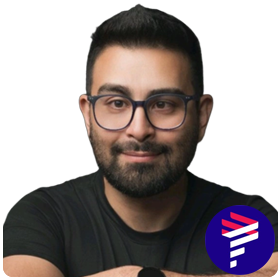
Head of AI & Data Platform, LATAM Airlines
About the Speaker:
Nicolás Venegas leads the AI & Data Platform organization at LATAM Airlines, South America’s largest airline: ~120 engineers building the foundation that lets the rest of the company validate or discard AI ideas at decreasing construction costs. In 2021 he founded Cosmos, a platform of reusable patterns that today powers 1,500+ data and AI products built by 600+ engineers, data scientists and analysts, with hundreds running in production in one of the most regulated industries in the world. Cosmos runs on a simple operating model: business domains define the what, the platform team defines the how, and forward-deployed engineers embed in the domains to build alongside them. That model is also where he sees agents break at scale: at the boundary between teams that own services and teams that build on them. Nicolás joined LATAM in 2019 after working as a software engineer, an ML engineer and a co-founder of an ML startup, and holds the Google Cloud Professional ML Engineer certification. He recently led a panel with LangChain in Santiago on what breaks when AI scales.
Most agent failures in production are not model failures. They are boundary failures.
As agents multiply inside an enterprise, two kinds of work emerge: owning a business service, and building an agent on top of it. These are rarely the same team, and the friction shows up fast. Domain knowledge lives with the service owner but has to be encoded in the agent, so agent builders re-create it in prompts and it drifts. A “skill” (a domain’s business capability packaged for agent use) gets treated as an API wrapper, so nobody clearly owns it. Observability tells the skill owner that a call succeeded, but not whether the agent used it correctly. And changing a shared skill silently breaks consumers nobody knew existed.
Drawing on our experience running a shared Data & AI platform at LATAM Airlines, and on a recent panel with LangChain on what breaks when AI scales, this talk gives practitioners a concrete model: how to define skill ownership, which contracts and signals must cross the boundary, and how to evolve shared skills safely. It covers both patterns: one team owning service and agent, and many teams building across boundaries.
MLOps World | GenAI Summit 2026 is a two days of case studies, workshops, and expo on taking AI/ML and agentic systems into production – at the Etter-Harbin Alumni photo – full-bleed hero or browse files.