Most AI risk doesn’t appear during development.
It appears later, when systems are scaled, monitored, handed off, and expected to run continuously.
That risk compounds as systems become more autonomous. Agentic workflows introduce longer execution chains, hidden dependencies, and decisions that unfold over time, often outside the narrow scope of a demo.
When there’s real traffic.
Real latency budgets.
Real cost curves.
Real operational pressure.
That timing mismatch is why production teams often feel blindsided. The demo went well. The launch looked fine. Then the system started drifting, degrading, or quietly accumulating operational debt until it became an incident.
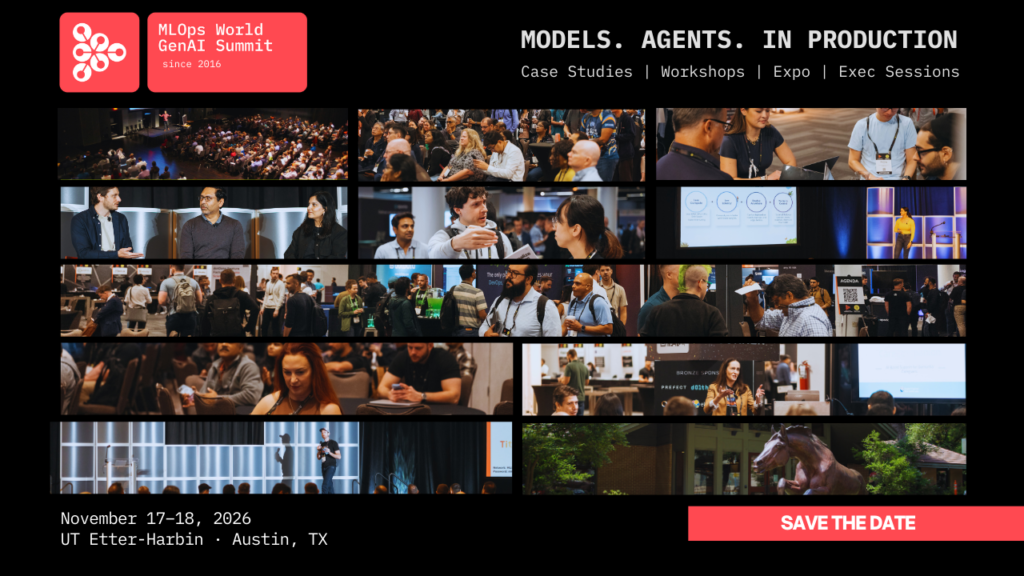
MLOps World | GenAI Summit exists for practitioners operating in that after-launch phase, where reliability, cost, ownership, and control become unavoidable.
📍 Austin, Texas
📅 November 17–18, 2026
Save the dates.
The failure rarely announces itself on day one
Production AI doesn’t always “break.” It often erodes.
The most consequential problems show up as slow-moving changes that are easy to miss in the early weeks:
- Model performance degrades in uneven pockets, not all at once
- Monitoring signals look “fine” until the business impact is already real
- Edge cases stop being edge cases once usage scales
- Costs climb gradually until they’re suddenly budget-visible
- Ownership gaps stay invisible, until there’s an incident and nobody has the call
This isn’t a theoretical risk. It’s what live systems do when they move from controlled conditions to sustained operation.
The handoff phase is where operational assumptions get tested
A common inflection point comes after the initial build:
The system is shipped. The team shifts to new priorities. The platform or infra group inherits pieces of the stack. The product assumes it’s “stable.” The on-call rotation becomes the real feedback loop.
That’s when assumptions get stress-tested:
- “We’ll add monitoring later.”
- “Rollback will be straightforward.”
- “Cost won’t be an issue until we’re bigger.”
- “Drift will be obvious.”
- “Ops owns the runtime; AI team owns the model.”
In production, these aren’t neutral statements. They become operational debt, and debt collects interest under load.
The recurring post-deployment failure patterns
Across years of practitioner-led curation at MLOps World | GenAI Summit, the same operating realities return, not as trends, but as repeatable failure modes in live systems:
1) Ownership boundaries that don’t hold during incidents
When something degrades, teams discover the boundary isn’t clear enough:
Who owns detection? Who owns rollback? Who can change thresholds? Who approves hotfixes? Who’s accountable for the bill?
2) Monitoring that’s built for dashboards, not decisions
Teams often have observability, but not decision-grade monitoring:
signals that reliably indicate drift early, distinguish data vs. infra issues, and trigger action before impact spreads.
3) Operational debt hidden inside “working” pipelines
Pipelines can appear stable until scale, dependency changes, or partial failures reveal brittleness:
orchestration fragility, tightly coupled steps, slow recovery paths, and failure modes that are hard to reproduce.
4) Cost behavior that shifts as usage becomes real
Cost doesn’t always spike at launch. It escalates with adoption:
data movement, feature compute, retrieval, retries, inference patterns, and “small” inefficiencies that compound at volume.
None of these problems are rare in production. They’re common precisely because the lifecycle timing is predictable: the risks mature after launch.
Why MLOps World is built around “what happened after deployment”
Many technical events gravitate toward what systems should look like.
MLOps World | GenAI Summit stays focused on what systems actually do once they’re running:
how they behave under load, what breaks after handoff, where teams underestimated complexity, and how operational reality reshapes architecture decisions.
That’s not a preference. It’s a credibility stance.
Because the people we serve aren’t optimizing for prototypes. They’re optimizing for:
- reliability over months, not weeks
- operational clarity across teams
- cost behavior under real usage
- systems that can be operated, not just launched
If you’ve ever inherited a system “after the demo phase,” you already understand why those stories matter.
What “practitioner-led curation” signals in practice
When we say MLOps World | GenAI Summit is curated by practitioners, we mean the selection lens is shaped by people who have carried production accountability, through incidents, tradeoffs, constraints, and on-call reality.
Over years, that creates a consistent filter:
- Does the story come from a live system with real constraints?
- Does it reflect long-term behavior (not launch-week behavior)?
- Does it surface ownership, monitoring, and operational debt honestly?
- Does it represent the messy boundary between AI, infra, and product?
This isn’t aspirational content. It’s real community lessons.
Save the dates
MLOps World | GenAI Summit (2026)
📍 Austin, Texas
📅 November 17–18, 2026